 |
 |
|
 |

The PeopleHere, in a series of capsule introductions, are the people behind the prints we are making at Mokuhankan. Not all the people will be involved in every print, and as time goes by I hope to involve a large number of the currently active craftsmen in our project, but here is a start ...  Papermakers: Mr. Ichibei Iwano (and family)
Iwano-san is now in his seventies, and certainly doesn't produce all the paper by himself. It is a cooperative affair among all family members, who share the labor of preparing the mulberry, dipping the sheets, and finishing them ready for shipping to the waiting printmakers. But no matter which member of the family dipped the particular sheet that forms the print you receive, it is never described as being anything but 'made by Iwano Ichibei' - who stands responsible for everything done in their workshop. Mokuhankan uses only paper Echizen Hosho - Iwano-san's finest paper - for all our prints. Printer: Mr. Shinkichi Numabe
His main day-to-day work is done in the studio of the Yoshida family, where he works on printing their editions (these days mostly prints designed by the late Toshi Yoshida), but he also takes on 'outside' work, and is perhaps best known for being the main printer of English printmaker Paul Binnie's editions. Numabe-san is responsible for some of the most difficult prints in our catalogue, notably Hilo Bay, and Aspen Grove. Printer: Yasue Tsushima
Meet the first of our Examples of Tsushima-san's work in our catalogue are Plum Blossoms in Moonlight, and a reproduction of a very delicate Hokusai surimono Two Women in a Boat. Printer: Ayumi Miyashita
Her initial interest was (and still is) in the making of the traditional printer's baren, but she realizes that the process of developing that skill will take a very long time, and even when she is 'ready' and hangs out her shingle, making a living at it might be quite some challenge. So she quite sensibly came to us and discussed whether or not she could work as a printer as well. (And honestly speaking, there could be no better training for a baren maker than becoming a good printer, of course!). She started her training in the early summer of 2012, and very quickly reached the point where her work became ready for our catalogue. She has become so good at this that the question of her future as a baren maker is perhaps something that we don't talk about much here ... In any case, for the time being, as long as she is willing to study and work with us, she's welcome! Examples of Ayumi-san's work in our catalogue are Peony and Sparrow, and a reproduction of a Hokusai book illustration Soshi the Philosopher. Designer: Jed Henry
Partner Shop: Yoshida Studio printer, Shinkichi Numabe
The Yoshida Studio no longer issue prints from the blocks prepared by Hiroshi (who died in 1951), but do offer printings of designs by Toshi (who passed away in 1995). Numabe-san works in a room on the ground floor of the studio itself, and pulls these prints from the original blocks under direct family supervision, using the sample prints (and proofing instructions) left by his predecessors. Each print is stamped with Toshi-san's signature, along with (in the case of the larger prints) an English title. They differ from those issued during Toshi's lifetime only in the lack of the actual pencil signature. The paper used is the identical type, from the same maker who has been providing the Yoshida Studio with paper for decades - Mr. Kazuo Yamaguchi. Numabe-san's current selection of Toshi Yoshida prints in our catalogue can be viewed here. Mokuhankan proprietor: David Bull
Print publishers have come and gone over the years, mostly 'gone' these days. A couple of the Tokyo outfits have dabbled a bit with the internet, but they certainly don't grok the web, and their websites can't be doing much for their business. What is needed is somebody who knows a good bit about printmaking, someone who can bring a fresh viewpoint about what can be produced (instead of re-hashing the 'same old same old' all over again), someone who can communicate with the craftsmen in their own language, someone who has at least some ability to 'get the message out' (both domestically here in Japan, and overseas), and ... perhaps most importantly, someone who is enthusiastic about all this stuff. Can I have a show of hands? ... I thought so ... Nobody here but me! :-) So there you have it, the basic 'crew'. Watch this space for further developments! |
 |
 |
 |
 We are now down to the last three families making premium quality paper for traditional printmaking. There are actually hundreds of papermakers scattered around the country, but it is only these three who specialize in the Echizen hosho that has been the standard for top quality prints ever since the mid Edo period. We are using paper made by Mr. Ichibei Iwano, who is the 9th generation of his family to carry that name, and who a few years back received the rare honour of being named a Living National Treasure, as did his father before him.
 I was never in doubt as to who to select for the man to do the first printing jobs for Mokuhankan. Numabe san is not only my age (to within a couple of weeks!), but also shares my concern for the current state of our craft. He too, is disappointed with what he sees becoming the 'normal' standard these days, and is intent on doing what he can to
  We realized quite some time ago that we will never be able to build a flourishing print publishing enterprise by depending on 'outside' printers. There are simply not enough good ones left, and those who are good, are busy. Neither Numabe-san nor Tetsui-san (introduced above) can take on very much more of our work. There is only one way forward - to train our own people.
 Ayumi-san has come to us from far-off Hokkaido. After leaving high school in the spring of 2012, she headed for the big city with one thought in mind - get some training at becoming a craftsman in the woodblock printmaking field. (Yes, there are still such people!)
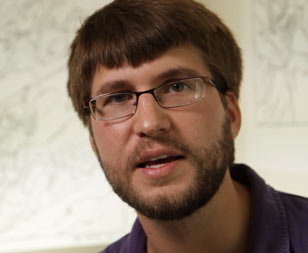 It was a fortunate mix of ingredients that formed author/illustrator Jed Henry. Barefoot summers on the Ohio River. Painting trips in the country with his mom. A few years spent roaming the streets of Tokyo. Jed thanks his lucky stars for all these experiences, and draws on them daily to flavor his books. Jed believes that in telling a story, both the teller and the reader need to be having a good time. When Jed creates an illustration, he's always surprised by what happens on the page, and he hopes his viewers will be delighted as well. Jed currently lives in small town in the Rocky Mountains with his brilliant wife and beautiful daughters. When he's not writing and illustrating, Jed makes animated films.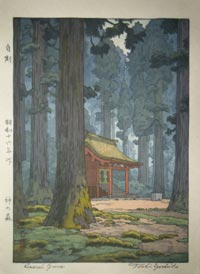
 I don't want to talk too much about myself here. If you have wandered around
|
Concept | People | Prints | Tools | Conversations
|
|
